

Introduction
Coconut sugar vs palm sugar is a common comparison among buyers, distributors, and food manufacturers looking for natural sweetener options. Understanding the differences between these two products is essential to choose the right one for your market, application, and supply needs.
Although these two natural sweeteners are often considered similar, they come from different sources and have distinct characteristics. Choosing the right product depends on your market needs, product application, and supply requirements.
What Is Coconut Sugar?
Coconut sugar is a natural sweetener made from the sap of coconut palm trees. The sap is collected, heated, and evaporated to form granulated sugar.
Key characteristics:
- Light to dark brown color
- Fine granulated texture
- Mild caramel sweetness
- Easy to dissolve
It is commonly used in beverages, baking, and processed food products.
In global trade, the discussion around coconut sugar vs palm sugar often focuses on consistency, taste, and scalability.
What Is Palm Sugar?
Palm sugar is a broader term that refers to sugar derived from various types of palm trees, including date palm, sugar palm, and coconut palm.
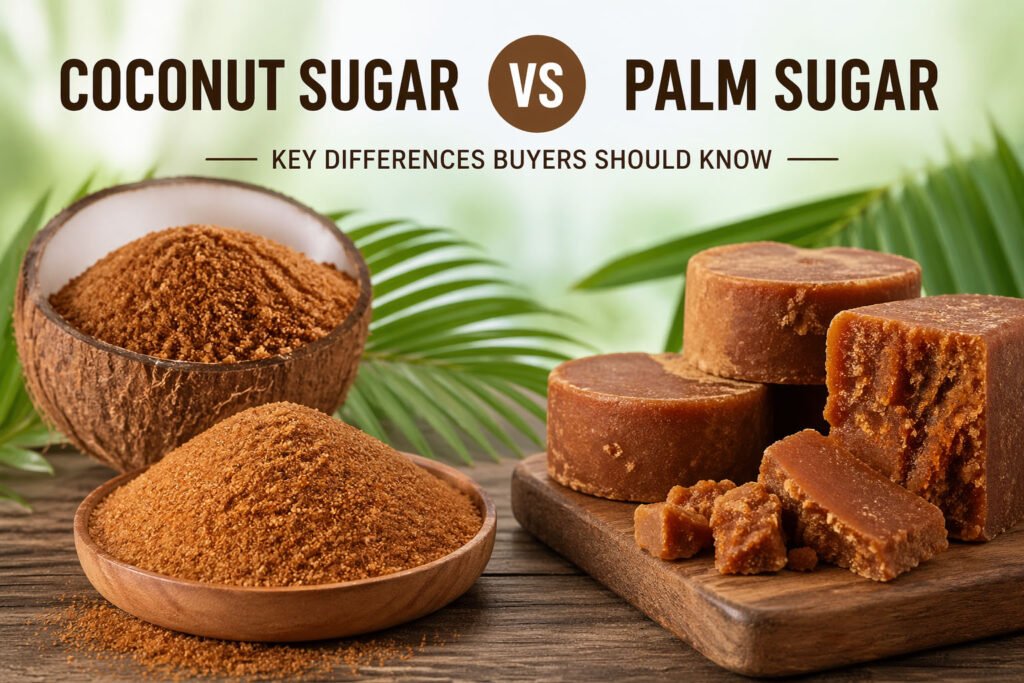
In many markets, palm sugar is often associated with traditional solid forms.
Key characteristics:
- Darker color
- Stronger taste
- Usually in block or paste form
- Less uniform texture
Palm sugar is widely used in traditional cooking and regional food applications.
Coconut Sugar vs Palm Sugar: Main Differences
1. Source
- Coconut sugar → from coconut palm sap
- Palm sugar → from various palm species
2. Texture and Form
- Coconut sugar → mostly granulated
- Palm sugar → commonly solid blocks or paste
3. Taste Profile
- Coconut sugar → mild and balanced
- Palm sugar → stronger and more intense
4. Market Application
- Coconut sugar → food industry, beverages, retail
- Palm sugar → traditional cooking and specialty products
5. Consistency
Coconut sugar offers more consistent quality for large-scale production, while palm sugar can vary depending on traditional processing methods.
Which One Is Better for Your Business?
The choice between coconut sugar vs palm sugar depends on your target market.
Choose coconut sugar if you need:
- Consistent quality for production
- Easy-to-use granulated form
- Global market compatibility
Choose palm sugar if you focus on:
- Traditional products
- Strong flavor profile
- Regional markets
Why Many Buyers Prefer Coconut Sugar
In international trade, coconut sugar is more widely used due to its consistency and scalability.
For bulk buyers and manufacturers, coconut sugar offers:
- Standardized quality
- Easier handling and storage
- Better integration into production systems
This makes it a preferred option for global supply chains.
Coconut Sugar Supply from Indonesia
Indonesia is one of the leading producers of coconut sugar, supplying international markets with stable volume and competitive pricing.
Working with a reliable supplier ensures consistent product quality and smooth export processes.
Conclusion
The comparison of coconut sugar vs palm sugar shows that both products have their own advantages depending on application.
However, for global buyers looking for consistency, scalability, and export readiness, coconut sugar remains the more practical choice.
Get Reliable Coconut Sugar Supply
If you are looking for a consistent and export-ready coconut sugar supplier, we are ready to support your business.
👉 Contact us for product details, pricing, and bulk supply options.
👉 Our team will respond within 24 hours.